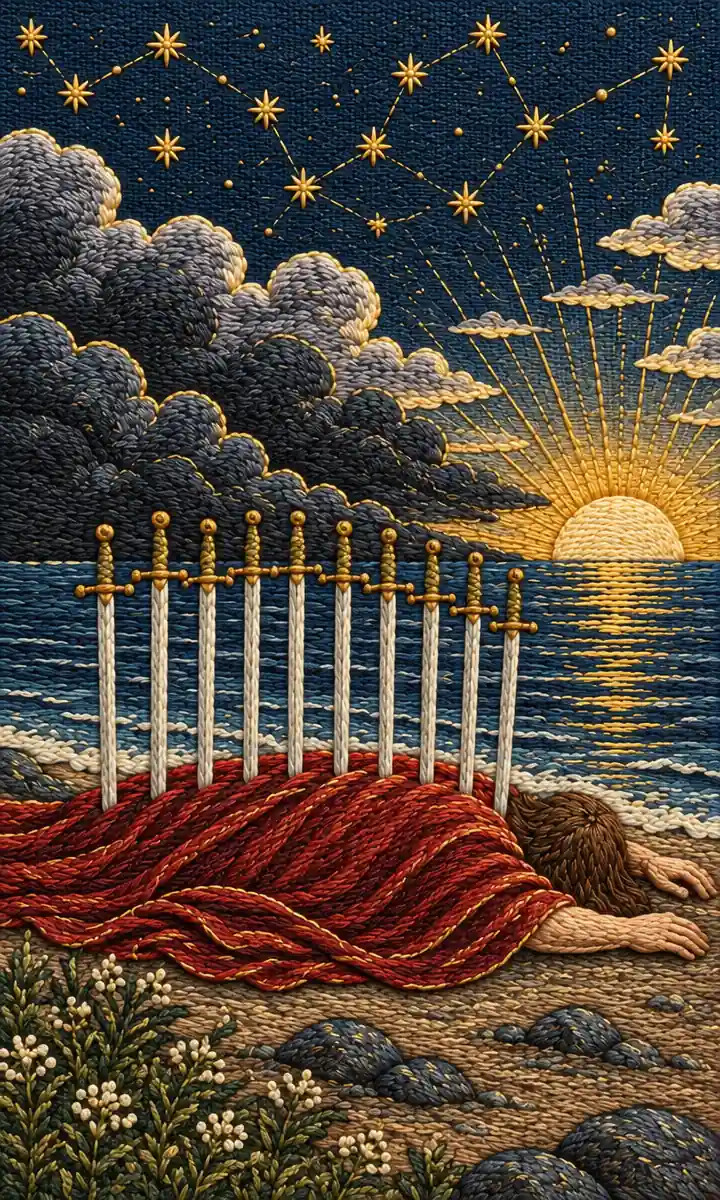
Ten of Swords
Thoth: Ruin
Marseille: Dix d’Épées
“The worst has landed. Past it, the light is coming up.”
At a glance
Keywords
an ending · rock bottom · collapse · betrayal · finality · the worst is over
Yes or no
No
This path is over, and the next one starts after it.
Keywords, reversed
a slow recovery · rising again · refusing to let it end · lingering · the dawn
Yes or no
Lean yes
Once you stop defending what has already ended.
Advice for
Accept the ending and tend to yourself. The lowest point is also a place to start.
Advice against
Don’t stage the disaster, or keep pressing on a wound that’s already done.
Meaning
The Ten of Swords is the end of the road for a way of thinking, a plan or a situation. The blow has fallen, and it’s total. A job, a relationship, a belief or a story you’ve been telling about your life is over. The card is the plainest picture of it: there’s nothing left to defend, and nothing more to lose.
The card is also the one where it can’t get worse, and yet the dark isn’t the whole story. In a reading it often says the pain is real and has a floor, and that this is the lowest point and not the beginning of one. The ending may be sudden. Stop arguing with it, grieve what you can, and let the light come in slowly.
In the Thoth deck
The Thoth deck calls it Ruin, and its disaster is of the mind: reasoning run mad and cut off from reality, a central point shattered until even logic itself is in splinters.
In the Marseille deck
Ten is completion and swords are thought: curved blades gathered in an oval, with two straight swords crossing near the top, thinking carried through to its end.
Reversed
Reversed, the Ten often shows a slow rising after the worst. You’re beginning to recover, to stand a little, to see that it ended and you didn’t. It can also be an ending that is dragged out: a collapse you keep reopening, or a loss you won’t let finish.
Where something is already over, let it be over. Recovery is slower than the blow, and it counts: rest first, and rebuild only what you can hold.
Shadow
Keywords
martyrdom · drama · collapse as a story · overkill · pessimism as armour
The card’s clear-eyed finality can turn into a performance. Every setback becomes a catastrophe, suffering becomes an identity, and an expectation of ruin protects you from hoping. The end is declared so often that no one hears it.
In your life
Love
A final break, or a long hurt reaching its end.
Reversed: slow healing; a breakup that drags.
Work
A dismissal, a project collapsing, burnout.
Reversed: rebuilding; clinging to what’s over.
Money
A loss that’s total and clear.
Reversed: a slow recovery.
Health and energy
Spent to the end of your reserves.
Reversed: energy returning in small steps.
Inner life
An old self-image ending.
Reversed: resisting the end; slowly standing up.
Spiritual keywords
surrender · ending · rebirth · humility · dawn
Timing
Sudden: the blow comes at once, and the light comes up slowly. Its season is the last ten days of Gemini, about 11 June to 20 June.
The image
Pamela Colman Smith draws a figure lying face down on the ground, with ten swords standing in the back and a red cloth over the legs. The sky is black, and a band of yellow light sits along the horizon over still water. Waite lists “pain, affliction, tears, sadness, desolation”. It is the end of something, and the dawn has already begun.
Frieda Harris puts the ten swords in the positions of the Tree of Life, with eight of them driving into the central sword and shattering it. The tenth is also in splinters. Crowley calls it the ruin of the intellect, of reason divorced from reality.
Dix d’Épées. Two bundles of curved blades bow into an oval, woven together where they cross at the top and bottom. Two straight swords cross near the top of the oval. There is no figure and no landscape. Ten is completion and the suit is thought: everything thought through to its end.
Place in the story
The Ten ends the suit of Swords: after the Nine’s sleepless night, the thinking finally runs out. What follows is the Page, a beginner’s watchfulness, and the next round of clear thinking after the ruin.
Correspondences
The Sun in Gemini rules the last decan: the planet of life and light set in the sign of quick thought, which scatters its rays. The Ten sits on Malkuth, the last point of the Tree of Life, where the suit’s energy reaches its limit. The Golden Dawn calls the card Lord of Ruin.
| Card | Ten of Swords |
|---|---|
| Element | Air |
| Astrology | Sun in Gemini, 3rd decan, 11 Jun to 20 Jun |
| Sephira | Malkuth |
| Golden Dawn title | Lord of Ruin |
| Card | Ten of Swords: Ruin |
|---|---|
| Element | Air |
| Astrology | Sun in Gemini, 3rd decan, 11 Jun to 20 Jun |
| Sephira | Malkuth |
| Golden Dawn title | Lord of Ruin |
| Card | Dix d’Épées |
|---|
The Marseille method uses no astrology or Kabbalah.
Card of the day
Something may end today, or you may finally let it. Don’t add more swords by arguing with it. Name what is over, treat yourself gently, and look for the first sign of light, however faint it is.
Journal prompts
- What has already ended that I am still defending?
- What is still standing after this that I hadn’t counted?
- What would I begin from here, if I allowed it to be over?
- Which way of thinking brought me here, and what would I try instead?
Common misreads
“A literal disaster.” The card is dramatic, but mostly marks an ending: of a plan, a story or a way of seeing.
“It will always be this bad.” The worst hour isn’t the whole story. The card marks the lowest point, and it passes.
Associations
- Playing card
- Ten of Spades.
- Myth and archetype
- Saint Sebastian pierced by arrows; the phoenix before the fire; Osiris cut to pieces and made whole.
Sources
RWS image and quotation: A. E. Waite, The Pictorial Key to the Tarot (1911), Ten of Swords; public domain.
Thoth image and title: Aleister Crowley, The Book of Thoth (1944), Ten of Swords, Ruin, paraphrased.
Marseille: Conver 1760 (BnF btv1b10520316w) has no Ten of Swords; arrangement from Jean Dodal, Tarot de Marseille (1701), BnF scans on Wikimedia Commons.
Decan, title, sephira: Golden Dawn Book T, via Regardie.
Practice meaning: Pollack, Greer and Bunning, paraphrased.
Practice: Arcanis Tarot, 10 of Swords, arcanistarot.com.