Twenty Years at the Table.
One more voice in the circle.
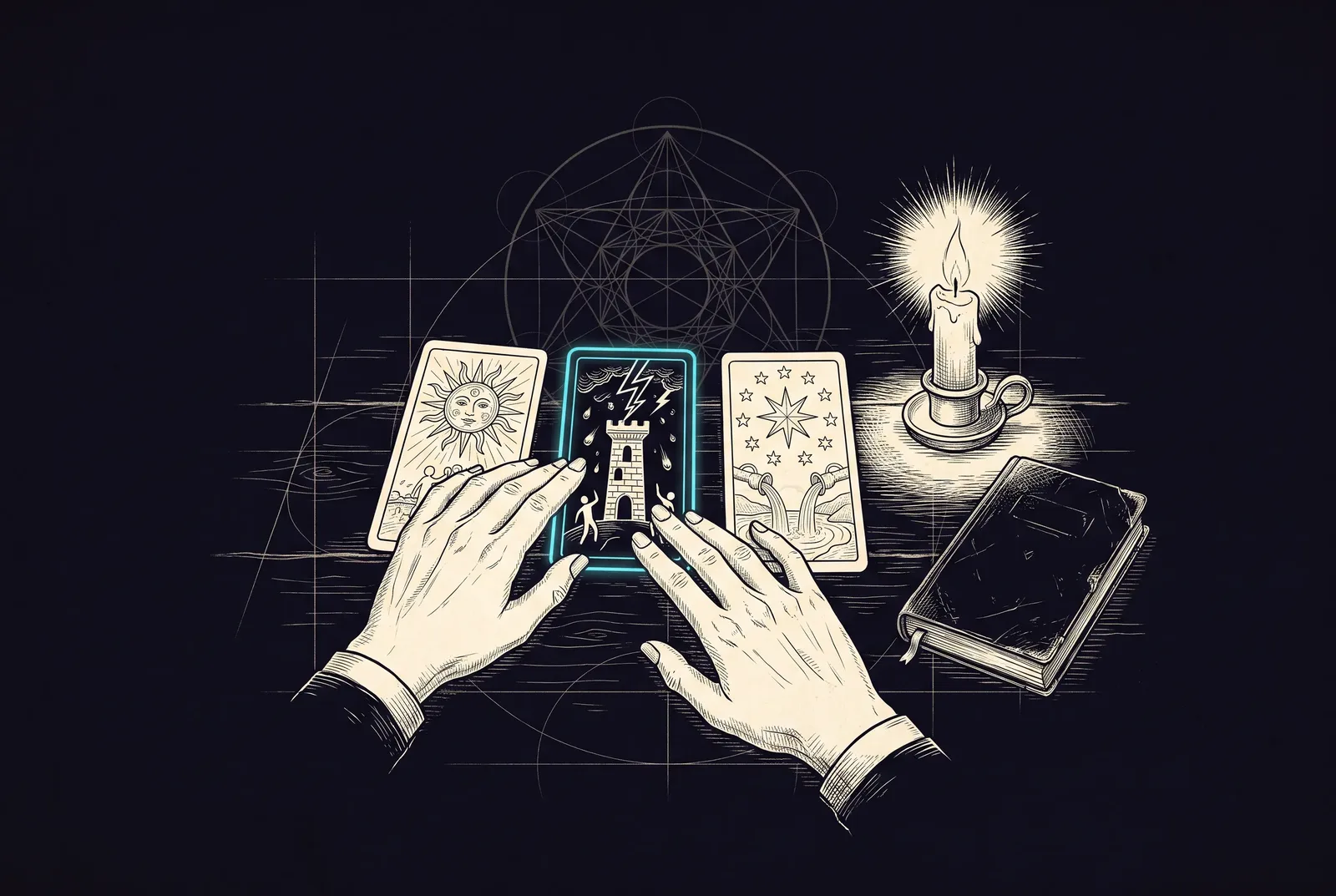
I've read tarot for about twenty years. By candlelight and in coffee shops, for friends in a hard spot, for strangers who mostly needed someone to listen, and more times than I can count for myself, late at night when I couldn't sleep. The deck started as a confidant, turned into a teacher, and over time became a mirror.
What I never had was a good record. My readings were scattered across notebooks, and by the next draw I'd forgotten what the last one said. I couldn't tell you which card kept coming back, or how a reading had played out. I wanted a journal that logs every reading and every card, and tracks them over time, so the threads would show.
I wanted one more thing: a librarian. I lost count of the books a long time ago. Waite, Pollack, Greer. Crowley and his tables of correspondences. Marseille readers I met in small bars in Europe. Golden Dawn attributions scribbled on the backs of receipts. Numerology, astrology, Kabbalah, the four humors. The cards kept asking more of me, and I kept following. Still, no one reader holds all of it. I pictured a digital librarian of the world's esoterica: a second reader who has read everything, and finds the right page when you reach for it.
I'm also a tech nerd. I like circuits and code about as much as candle wax and incense. So I built it myself, first as my own workbench, and I tuned it for months until it felt like a good reader sitting across from me: well read, respectful, and happy to stay out of the way.
Here's how it works. You read first, with your own deck or a digital draw, and write what you see in each card. The journal keeps it, encrypted, and over time shows the patterns your readings make. When you want a second reader, ask for an enhanced reading: a Woven reading, the shorter one, or a Tapestry, the longer and deeper one. Either builds on your words and never replaces them, and for a follow-up it remembers the reading before. The library is still growing. How enhanced readings work is in our Privacy Policy.
Then friends asked to use it, and then their friends did, and it was clear it shouldn't stay mine.
If you've ever turned a card and felt the answer before you had words for it, or wished for a study partner who has read every book on your shelf and never talks over your intuition, I made this for you. You bring the question, the cards and your own knowing. Spread Weaver keeps the record and brings the library. Whatever you make together is yours.
Welcome to the table.
The table scene images are mockups of what it might look like if our card illustrations were physical. Let us know if you want that to happen.