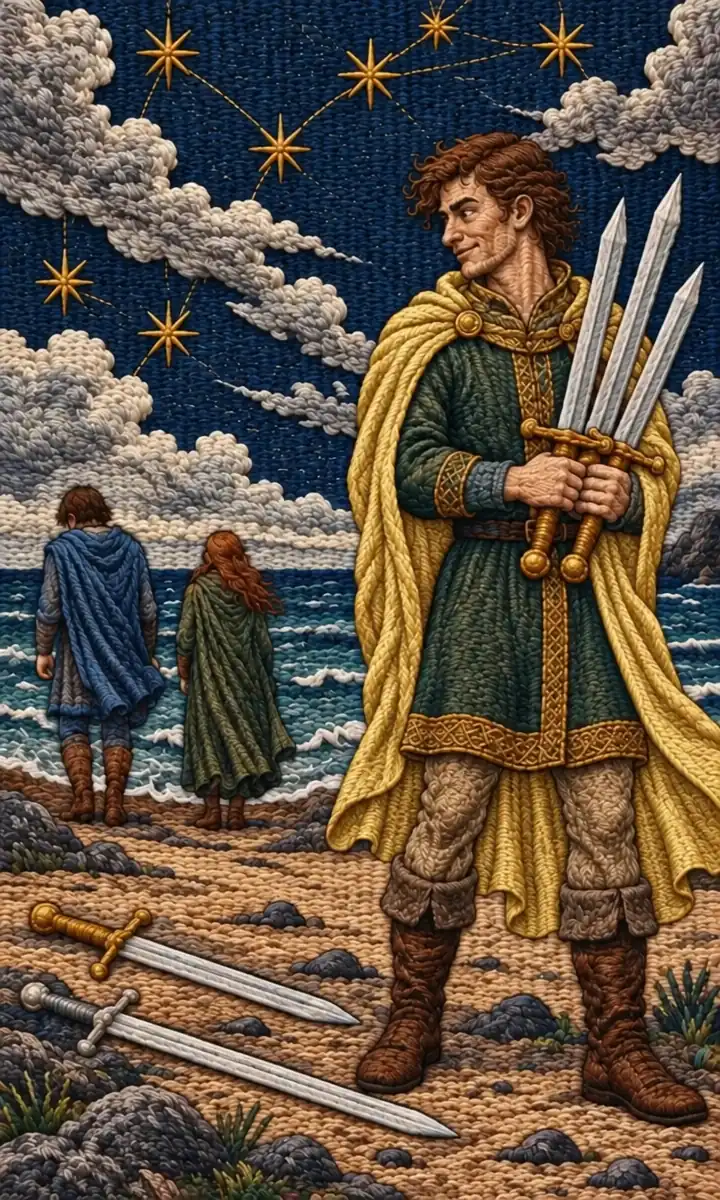
Five of Swords
Thoth: Defeat
Marseille: Cinq d’Épées
“You may take the field, and find nobody left to share it.”
At a glance
Keywords
conflict · a hollow win · tension · defeat · putting yourself first · a victory with a cost
Yes or no
Lean no
You may win the point and lose what it was for.
Keywords, reversed
reconciliation · walking away · regret · amends · a feud wearing out
Yes or no
Lean yes
Once the fight is over and amends begin.
Advice for
Ask what you actually want from this, then fight only for that.
Advice against
Don’t win in a way that costs you the people you wanted to keep.
Meaning
The Five of Swords is a quarrel with a price. Someone wins, someone walks away hurt, and the winner is left with the spoils and a quiet that feels wrong. The card asks who gets the field, and what it cost to take it.
It often shows up in arguments where being right has taken over from caring about the outcome: a negotiation pushed too far, a point scored in front of others, a competition where the other side was also a person. Sometimes you are the one walking away, beaten or fed up, and the card says you may be right to leave. Either way, ask what winning is for. The answer decides what the next move should be.
In the Thoth deck
The Thoth deck calls it Defeat, and reads it from the side of the loser: a mind weakened by sentiment, a failure of nerve or loyalty, and the sense that something has been undone from within.
In the Marseille deck
Five is friction and swords are thought: a bundle of blades in an oval, a straight sword upright in the middle, and every blade pulling against the rest.
Reversed
Reversed, the Five often shows the fight winding down. Regret arrives, someone reaches out, or you decide the point isn’t worth the damage. It can also be a feud that won’t stop: old resentments replayed long after the original quarrel.
If you are still fighting, find the smallest honest thing you could concede. If you were hurt, remember that ending it cleanly is a strength: decide whether the argument is worth another round, and say so.
Shadow
Keywords
gloating · winning at any cost · contempt · scorekeeping · goading
The card’s drive to win can turn into a way of living. Being right becomes the goal, other people become obstacles to goad or beat, and every conversation is a contest. The winner collects the spoils and finds the field has emptied.
In your life
Love
A bitter argument, or a win that left distance.
Reversed: apology; letting the quarrel end.
Work
Office politics, or a competition that went too far.
Reversed: ending a feud; amends.
Money
A deal won unfairly, or a settlement that stings.
Reversed: making it right; cutting your losses.
Health and energy
Tension and no peace from the argument.
Reversed: release as the fighting stops.
Inner life
Pride, and its cost.
Reversed: regret, and the wish to repair.
Spiritual keywords
humility · letting go · restraint · the cost of pride
Timing
Fast: a quarrel that flares and ends in a day or two. Its season is the first ten days of Aquarius, about 20 January to 29 January.
The image
Pamela Colman Smith draws a man with a smirk, holding one sword in his hand and two on his shoulder, as two figures walk away toward the water’s edge. Two more swords lie on the ground. Waite calls him “the master in possession of the field”. The sky is torn and the winner stands alone with his spoils.
Frieda Harris arranges five swords with their hilts in an inverted pentagram, each hilt different, the blades crooked or broken and drooping. Only the lowest sword points upward, and it is the weakest. The rose seen on the cards before it has fallen apart.
Cinq d’Épées. A sheaf of curved blades bows into an oval, crossed at top and bottom, with a straight sword upright in the centre. The blades press against each other. The number says friction and the suit says thought: minds in collision.
Place in the story
The Four’s truce does not last. The Five breaks the quiet with conflict, and someone loses. The Six follows as the retreat that conflict makes necessary: leaving the troubled shore for calmer water.
Correspondences
Venus in Aquarius rules the first decan: the planet of attraction and agreement in the sign of detachment and ideas, which is why the loss comes from feelings and loyalties, not strength. The Five sits on Geburah, severity, which breaks what holds together. The Golden Dawn calls the card Lord of Defeat.
| Card | Five of Swords |
|---|---|
| Element | Air |
| Astrology | Venus in Aquarius, 1st decan, 20 Jan to 29 Jan |
| Sephira | Geburah |
| Golden Dawn title | Lord of Defeat |
| Card | Five of Swords: Defeat |
|---|---|
| Element | Air |
| Astrology | Venus in Aquarius, 1st decan, 20 Jan to 29 Jan |
| Sephira | Geburah |
| Golden Dawn title | Lord of Defeat |
| Card | Cinq d’Épées |
|---|
The Marseille method uses no astrology or Kabbalah.
Card of the day
An argument may tempt you today, one you could win. Before you take it, ask what winning would cost and who would be left on the field. Choose the answer you’ll still be comfortable with tomorrow.
Journal prompts
- What am I fighting for, and what would it cost me to win?
- Who have I hurt by being right, and is there something I owe them?
- Where have I walked away from a fight, and was it defeat or good sense?
- Where do I dodge a fair argument, then let it leak out as digs or silence?
Common misreads
“You win.” The card shows a winner, and what the winner lost. Its question is whether you’d be glad to be the one holding them.
“Always fight your corner.” The card is a warning about winning badly. It doesn’t say never to stand up for yourself.
Associations
- Playing card
- Five of Spades.
- Myth and archetype
- Pyrrhus and his victories; Achilles and Agamemnon quarrelling over the spoils; the Bully.
Sources
RWS image and quotation: A. E. Waite, The Pictorial Key to the Tarot (1911), Five of Swords; public domain.
Thoth image and title: Aleister Crowley, The Book of Thoth (1944), Five of Swords, Defeat, paraphrased.
Marseille: Conver 1760 (BnF btv1b10520316w) has no Five of Swords; arrangement from Jean Dodal, Tarot de Marseille (1701), BnF scans on Wikimedia Commons.
Decan, title, sephira: Golden Dawn Book T, via Regardie.
Practice meaning: Rachel Pollack, Seventy-Eight Degrees of Wisdom; Mary K. Greer, The Complete Book of Tarot Reversals; Joan Bunning, learntarot.com, paraphrased.
Practice and archetype: Mark McElroy, A Guide to Tarot Card Meanings (2014, uncopyrighted), Five of Swords; Arcanis Tarot, 5 of Swords, arcanistarot.com.