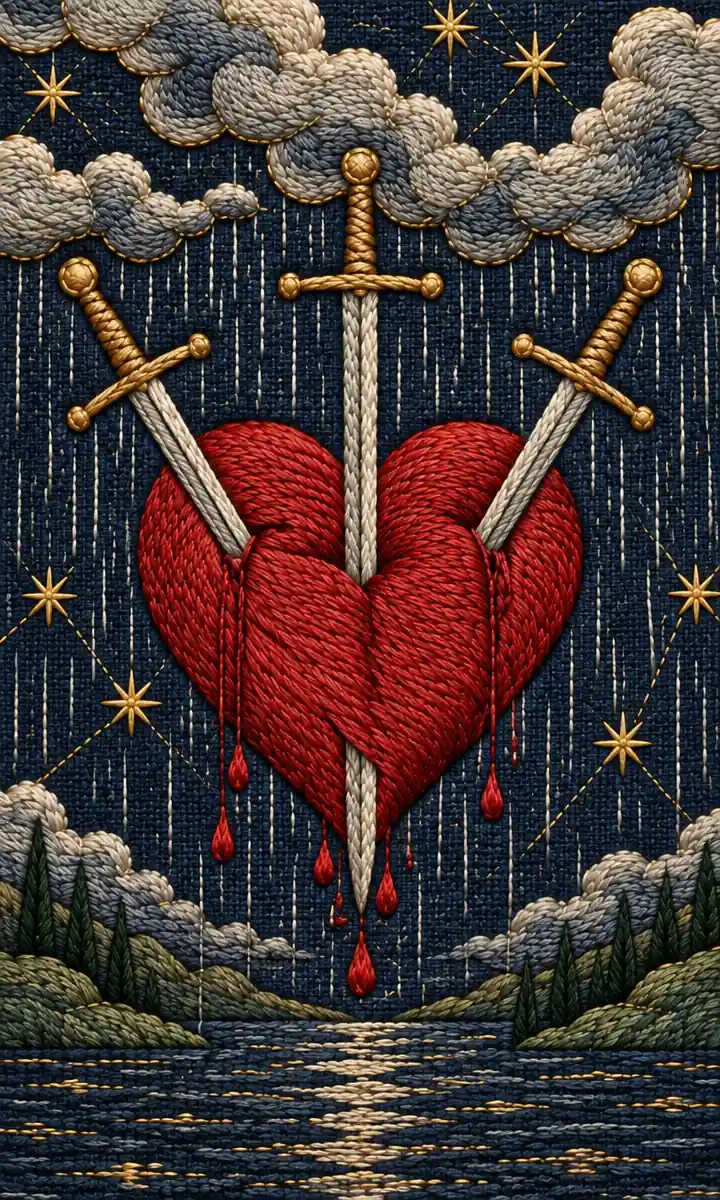
Three of Swords
Thoth: Sorrow
Marseille: Trois d’Épées
“The hurt is plain to see. Say it, and it can begin to heal.”
At a glance
Keywords
heartbreak · grief · painful truth · separation · betrayal · being let down
Yes or no
No
Not without hurt on the way, and not as you hoped.
Keywords, reversed
healing · letting the tears come · forgiving · an old wound reopened · pain held in
Yes or no
Lean yes
Slowly, once the grief has been allowed its time.
Advice for
Admit the hurt plainly and let someone see it. Grief that is witnessed moves.
Advice against
Don’t replay the wound as proof, or pass it on to whoever is nearest.
Meaning
The Three of Swords is a heart that has been struck. Something you counted on has gone, or something you’ve avoided knowing has finally been said. There may be a parting, a betrayal, a verdict on the situation you didn’t want to hear. The pain has a clean edge, and it is the card’s whole point.
It doesn’t come with a lesson attached. In a reading it often tells you to stop explaining the hurt away. Name it, feel where it lands, and let someone near enough to see it. The card is stark because the pain is not the same as its meaning, and meaning comes later, if at all. For now it’s enough to admit that this hurts.
In the Thoth deck
This card is Sorrow, dark and heavy. Crowley sets it in the great dark sea of understanding: a brooding grief where creative energy turns strange and secret.
In the Marseille deck
Three is growth and swords are thought: a thought that grows painfully, a clear mind pierced by what it now knows.
Reversed
Reversed, the Three often shows healing under way: tears at last, an apology made or accepted, the first light after a long grief. It can also mean the old wound has reopened because it was never fully tended.
Where the pain has been held in, it tends to leak out as tiredness, sharpness or numbness. Let it speak. Tell one person the plain version, or write it down, and give the hurt some time.
Shadow
Keywords
grief as identity · rehearsing the hurt · grievance · sharp tongue · hurting back · self-judgment
The card’s honesty about pain can harden into possession. The story of what happened becomes the thing you carry and retell, and the sting is kept alive because it proves you cared. Sometimes it turns inward as a harsh verdict on yourself. Hurt people can also hurt people, and call it truth.
In your life
Love
A break, a betrayal, or a truth that finally lands.
Reversed: mending, forgiveness, or grief still being carried.
Work
A harsh verdict, a loss, a difficult exit.
Reversed: recovering from a blow; clearing the air.
Money
A painful loss or a split.
Reversed: recovering, or bad news you’ve held back.
Health and energy
Heaviness and tears; go gently.
Reversed: energy slowly returning.
Inner life
Sorrow that wants to be felt.
Reversed: letting it go, or burying it again.
Spiritual keywords
grief · compassion · honesty · the broken-open heart
Timing
Sudden, then slow: the blow comes quickly and mending takes its time. Its season is the middle ten days of Libra, about 3 October to 12 October.
The image
Pamela Colman Smith draws a red heart pierced by three swords, one through the centre and one on each side, against grey cloud and falling rain. There is no figure and no landscape, only the heart. Waite says the design is too simple and obvious to need much explanation, and it is: the hurt is the picture.
Frieda Harris shows a great sword, point upward, driven through the meeting place of two shorter curved swords. Crowley describes the blow as having destroyed the rose that was there, with a storm brooding under an implacable night. Nothing in it is gentle: this is the Mother as darkness, not comfort.
Trois d’Épées. Two curved blades bow into an oval, and a straight sword stands upright between them. The three blades are held in a tight frame with no figure and no scene. Three brings growth and swords bring thought: a mind pressed into shape.
Place in the story
The Two held its breath; the Three is what breaks: the stalemate gives way, and the heart feels it. The Four follows with retreat, the rest that comes when the blow has landed and grief needs somewhere to lie down.
Correspondences
Saturn in Libra rules the second decan, and Saturn is exalted in Libra: the planet of limits and time at its most just, which fits grief that is clean and fair. The Three sits on Binah, the dark sea of the great mother, a place of sorrow and form. The Golden Dawn calls the card Lord of Sorrow.
| Card | Three of Swords |
|---|---|
| Element | Air |
| Astrology | Saturn in Libra, 2nd decan, 3 Oct to 12 Oct |
| Sephira | Binah |
| Golden Dawn title | Lord of Sorrow |
| Card | Three of Swords: Sorrow |
|---|---|
| Element | Air |
| Astrology | Saturn in Libra, 2nd decan, 3 Oct to 12 Oct |
| Sephira | Binah |
| Golden Dawn title | Lord of Sorrow |
| Card | Trois d’Épées |
|---|
The Marseille method uses no astrology or Kabbalah.
Card of the day
Something may hurt today, or you may finally say a hurt out loud. Don’t argue with it, and don’t dress it up. Be honest with one person you trust, and let the day be gentle with you.
Journal prompts
- What hurt am I still treating as if it didn’t happen?
- Who could I tell the plain version to, without needing them to fix it?
- What would forgiving look like, and what am I not ready to forgive yet?
- Between the hurt and my reply, is there room to choose how I answer?
Common misreads
“Someone is about to be betrayed.” The card is pain, not a verdict on anyone. It may be loss, grief or a hard truth, with no villain.
“The grief is permanent.” The Three is sharp, not endless. It marks the wound; healing is what comes after it.
Associations
- Playing card
- Three of Spades.
- Myth and archetype
- Mater Dolorosa with the seven swords; Demeter’s grief; Hamlet’s cry; the Wounded Healer.
Sources
RWS image: A. E. Waite, The Pictorial Key to the Tarot (1911), Three of Swords; public domain.
Thoth image and title: Aleister Crowley, The Book of Thoth (1944), Three of Swords, Sorrow, paraphrased.
Marseille: Conver 1760 (BnF btv1b10520316w) has no Three of Swords; arrangement from Jean Dodal, Tarot de Marseille (1701), BnF scans on Wikimedia Commons.
Decan, title, sephira: Golden Dawn Book T, via Regardie.
Practice meaning: Pollack, Bunning and Greer, paraphrased.
Practice: Mark McElroy, A Guide to Tarot Card Meanings (2014, uncopyrighted), Three of Swords; Arcanis Tarot, 3 of Swords, arcanistarot.com.