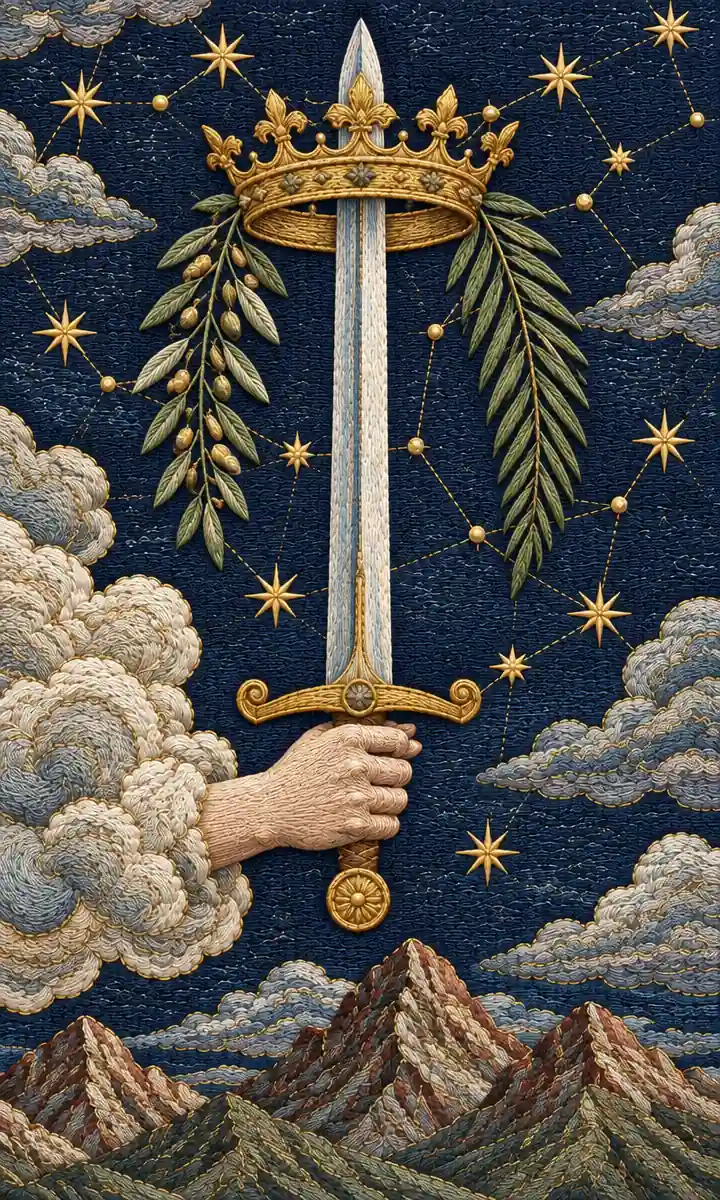
Ace of Swords
Marseille: As d’Épées
“One clear thought cuts through the fog. Now you can see.”
At a glance
Keywords
clarity · breakthrough · the truth said plainly · a clean decision · mental force · a new idea
Yes or no
Yes
The facts are clear enough to act on, as long as you act on what is true.
Keywords, reversed
confusion · a muddled message · a blunt edge · words that cut · a decision held back
Yes or no
Lean no, for now
The confusion hasn’t lifted; decide once you know what you are deciding.
Advice for
Say the true thing plainly, then decide. Clear thinking asks for a clear next step.
Advice against
Don’t use the truth as a blade. A fact can be exact and still be thrown carelessly.
Meaning
The Ace of Swords is the moment a thought turns into something sharp. A muddle clears, a name is finally put to the problem, or an idea arrives that you can’t unthink. It often comes as a flash of understanding, a straight answer, or the nerve to say what has been avoided.
The crown on the blade says this clarity carries weight. It can win an argument, settle a question or cut through a tangle, and it works on whoever holds it as much as on anyone else. Truth is the point of the card, so ask whether you want the answer or only the comfort of the doubt. Once you can see, you are asked to act on it.
Reversed
Reversed, the blade is blunt or pointed the wrong way. Thinking goes round without landing, a message gets garbled, or you know something and haven’t said it. It can also show words used as a weapon, such as a harsh remark that was only half thought through.
Slow down and find the one clear sentence underneath the noise. Write it out or say it to someone steady before you decide anything.
Shadow
Keywords
coldness · being right at any cost · cutting remarks · ruthless logic · snap judgments
The card’s clean edge can harden into a habit. Clarity turns into a wish to win, and the truth is told because it hurts, not because it helps. A mind sure of the answer stops listening, and a snap judgment passes for clear sight.
In your life
Love
An honest conversation that clears the air.
Reversed: sharp words, or something unsaid.
Work
A clear idea, a decision, a pitch that lands.
Reversed: mixed messages; a plan not ready.
Money
Seeing the numbers as they are.
Reversed: a decision made on bad information.
Health and energy
A clear head after a muddled stretch.
Reversed: an overworked mind that won’t switch off.
Inner life
Naming what you’ve known for a while.
Reversed: overthinking, or avoiding the thought.
Spiritual keywords
discernment · insight · honesty · the clear mind
Timing
Sudden: it arrives as a flash, a conversation or a single decision. The Ace has no season of its own, and the clarity tends to come first and the changes after.
The image
Pamela Colman Smith draws a hand from a cloud holding an upright sword with a crown on its tip. Leafy sprigs hang from the crown, and small yellow drops fall below, over distant mountains. Waite says the crown “may carry a much higher significance” than fortune-telling usually reaches. It is the mind’s sharpest tool, offered from above.
Frieda Harris paints the Sword of the Magus, crowned with a twenty-two-rayed diadem of light. Crowley says the blade carries the Word of the Law, and its blaze scatters the dark clouds of the mind. This is thought as pure force, before anyone has used it.
The As d’Épées on the Conver pattern shows a hand reaching in from the clouds at the left edge, holding a sword whose blade passes up through a crown, wreathed in leaves, with a spray of flames falling around it. One thing, held up: the start of thought.
Place in the story
The Ace opens the suit of Swords, before any argument or sorrow has formed: the idea at its clearest and least tested. The Two comes next and asks what you will do when the mind has to hold two sides at once.
Correspondences
The suit of Swords belongs to Air, the element of thought, speech and the breath between people. The Ace is the root of that element and sits on Kether, the first point of the Tree of Life, where everything that follows is still gathered in one. The Golden Dawn calls it the Root of the Powers of Air.
| Card | Ace of Swords |
|---|---|
| Element | Air |
| Sephira | Kether |
| Golden Dawn title | Root of the Powers of Air |
| Card | Ace of Swords |
|---|---|
| Element | Air |
| Sephira | Kether |
| Golden Dawn title | Root of the Powers of Air |
| Card | As d’Épées |
|---|
The Marseille method uses no astrology or Kabbalah.
Card of the day
A thought sharpens today, or someone says exactly what needs saying. Don’t soften it until it means nothing, and don’t swing it either. Let the clean version be true for a moment before you decide what to do.
Journal prompts
- What do I already know that I haven’t said out loud?
- Where would a plain, kind sentence do more than another round of thinking?
- When has the truth helped me, and when did I use it to win?
Common misreads
“A win over someone.” The victory is clarity, not conquest. The card doesn’t say you have to defeat anyone.
“Thinking is enough.” The blade is for cutting. An insight that never becomes a decision stays an idea.
Associations
- Playing card
- Ace of Spades.
- Myth and archetype
- The sword of Damocles; Excalibur lifted from the water; Athena’s clear-eyed reason; the Truth-teller.
Sources
RWS image and quotation: A. E. Waite, The Pictorial Key to the Tarot (1911), Ace of Swords; public domain.
Thoth image: Aleister Crowley, The Book of Thoth (1944), Ace of Swords, paraphrased.
Marseille: Nicolas Conver, Tarot de Marseille (1760), BnF btv1b10520316w, As d’Épées.
Element, sephira, title: Golden Dawn Book T, via Regardie.
Practice meaning: Rachel Pollack, Seventy-Eight Degrees of Wisdom; Joan Bunning, learntarot.com; Benebell Wen, Holistic Tarot; Mary K. Greer, The Complete Book of Tarot Reversals, all paraphrased.
Practice: Mark McElroy, A Guide to Tarot Card Meanings (2014, uncopyrighted), Ace of Swords.