Six of Cups
Thoth: Pleasure
Marseille: Six de Coupes
“A small kindness, passed hand to hand, from a place you remember.”
At a glance
Keywords
nostalgia · childhood · memory · kindness · innocence · reunion
Yes or no
Lean yes
It rests on goodwill and a history you can trust.
Keywords, reversed
stuck in the past · idealising · growing up · letting go · old patterns · moving on
Yes or no
Lean no
Not while you’re steering by how things used to be.
Advice for
Reach out to someone from your past, or take the comfort of a memory. Let it teach you something.
Advice against
Don’t live in a version of the past that never existed, or compare the present to it.
Meaning
The Six of Cups is the pull of the familiar. A smell, a song, an old friend, a place you grew up in, and suddenly you’re warm with memory. The card is gentle. It speaks of simple generosity, of someone offering you something with no reason except that they can.
Look for the past arriving in the present: a reunion, a childhood theme coming back, a kindness you’d forgotten you were owed. It asks you to take the comfort and the lesson, both. What you were given then can still feed you now.
In the Thoth deck
This card is Pleasure in its highest sense: well-being and ease, natural forces in harmony without strain. Crowley counts it among the best and most fertile cards in the pack. Read it as contentment now, more than memory.
Reversed
Reversed, the memory becomes a trap or a door closing. You may be holding on to a golden age that wasn’t quite as golden, or running the same old patterns because they feel like home. It can also show a healthy leaving behind: growing out of an old role, or a family story you’ve outgrown. Honour what it gave you, then ask which parts of the past you’re still living by habit.
Shadow
Keywords
sentimentality · a rewritten past · refusing to grow · innocence as an excuse
At its best this card gives and receives without calculation. The shadow is innocence used as a shield: staying childlike so as to avoid responsibility, or keeping a version of history in which nothing was your fault. Kindness turns into a debt the other person is expected to keep paying.
In your life
Love
An old friend or flame, or tender, uncomplicated affection.
Reversed: comparing a partner to the past.
Work
A returning colleague, or work that draws on early skills.
Reversed: staying in a role you’ve outgrown.
Money
An inheritance, a family matter, generosity without strings.
Reversed: old money habits holding you.
Health and energy
Comfort from familiar routines and places.
Reversed: stuck in habits that no longer fit.
Inner life
Reconnecting with your younger self.
Reversed: an old story that needs rewriting.
Spiritual keywords
innocence · remembrance · tenderness · play · gratitude
Timing
Slow: the past surfaces at its own pace. Its season is the second ten days of Scorpio, about 2 November to 11 November.
The image
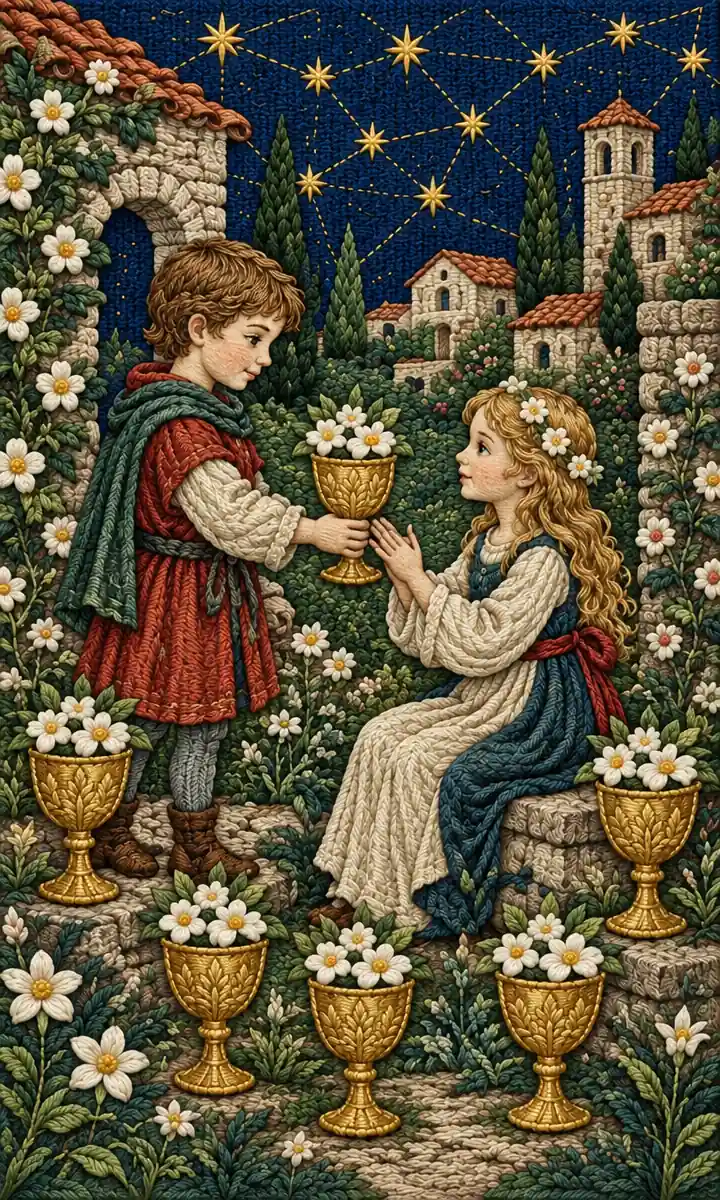
Pamela Colman Smith sets two children in an old walled courtyard, a stone tower and gabled houses behind. The taller one, hooded in red, hands a cup of white flowers to the smaller. Four more cups of the same flowers line the foot of the card, and another sits on a stone block marked with an X-shaped cross. A figure walks off in the distance.
Frieda Harris paints lotus stems grouped in a dancing movement, their blossoms pouring water into six cups. The cups aren’t yet full to overflowing, as they will be in the Nine. Crowley says Pleasure here means well-being and ease, not the pursuit of appetite.
Six de Coupes. Six cups in three rows of two, set along a central stem that flowers at its middle. The arrangement is balanced and quiet, each cup with a partner. Six is balance, and cups are feeling: a heart at peace with what it has been given.
Place in the story
The Six answers the Five’s loss with memory and gentleness: a way back to what once felt safe. It heals by remembering. The Seven follows with the opposite pull: a future crowded with so many tempting cups that none of them can be trusted.
Correspondences
The Sun in Scorpio rules the second ten days of the sign. Scorpio works in the dark, in decay and renewal, and the Sun brings it light: what has been buried feeds new growth. The six sits on Tiphareth, the heart of the Tree, where beauty and balance meet. The Golden Dawn calls the card Lord of Pleasure.
| Card | Six of Cups |
|---|---|
| Element | Water |
| Astrology | Sun in Scorpio, 2nd decan, 2 Nov to 11 Nov |
| Sephira | Tiphareth |
| Golden Dawn title | Lord of Pleasure |
| Card | Six of Cups: Pleasure |
|---|---|
| Element | Water |
| Astrology | Sun in Scorpio, 2nd decan, 2 Nov to 11 Nov |
| Sephira | Tiphareth |
| Golden Dawn title | Lord of Pleasure |
| Card | Six de Coupes |
|---|
The Marseille method uses no astrology or Kabbalah.
Card of the day
Today, something from the past may come back, or ask for a kind word. Take a moment with it. Call someone you’ve lost touch with, or do one thing the way you did as a child, and see what it brings up.
Journal prompts
- What memory from childhood still warms me, and what does it ask of me now?
- Where am I measuring the present against a past that’s softened with time?
- Who gave me something freely, and have I thanked them?
- What could I give this week with no thought of being repaid?
Common misreads
“It’s all in the past.” The card brings the past into the present. What returns is meant to be used now.
“A sweet card with no edge.” Looking back can also keep you from looking ahead. Nostalgia can comfort or confine.
Associations
- Playing card
- Six of Hearts.
- Myth and archetype
- The Golden Age; the Garden before the Fall; the inner child.
Sources
RWS image: A. E. Waite, The Pictorial Key to the Tarot (1911), Six of Cups; public domain.
Thoth image and attribution: Aleister Crowley, The Book of Thoth (1944), Six of Cups, Pleasure.
Marseille: Nicolas Conver, Tarot de Marseille (1760), BnF btv1b10520316w, Six de Coupes; number and suit method as in the Marseille tradition notes.
Meaning in practice, Six of Cups: Rachel Pollack, Seventy-Eight Degrees of Wisdom; Joan Bunning, learntarot.com; paraphrased.
Golden Dawn decan, title and sephira, Six of Cups: Book T, as published by Regardie.
Practice: Mark McElroy, A Guide to Tarot Card Meanings (2014, uncopyrighted), Six of Cups.